Adro
GR Supra MK5 Aero Kit by ARD (Adro Racing Division)
GR Supra MK5 Aero Kit by ARD (Adro Racing Division)
Couldn't load pickup availability
Aero over aesthetic. Function over form. Purpose over compromise.
What is ARD?
ARD (ADRO Racing Division) is ADRO's motorsport engineering program, built for drivers who demand more from their car on track. Every ARD component is developed through CFD simulation and track tested before anything reaches a customer. Scott, ADRO's Head of Aerodynamics, brings an F1 development background to every ARD project. The GR Supra ARD Aero Package is the one of the first full systems to come out of that program.
The Front Splitter
Most front splitters are flat panels. They add some visual aggression, generate a modest amount of downforce at the nose, and leave everything else to chance. The ARD front splitter is designed around a different idea: that the front of the car isn't just a downforce source — it's the starting point of a complete aerodynamic strategy that has to be managed all the way to the rear diffuser.
How It Works
Upper vanes condition the airflow over the outer splitter surface, creating and powering the vortices under the splitter endplate tunnels. Lower strakes control outwash across the splitter, preventing spillage and maximizing effective working area. The F1-inspired endplates initiate strategic vortex generation down the car's sides, working with the V2 sideskirts to extract more air and drive more flow under the front end.
The Quad Canards
Canards are one of the most visually recognizable elements in motorsport aero. They are also one of the most misused. On most aftermarket kits, they are aesthetic additions that generate marginal front downforce and little else. The ARD quad canards are developed to do something more specific: manage the vortices initiated by the front splitter assembly and direct airflow around the front wheels.
How It Works
The front wheels are one of the largest sources of aerodynamic drag and turbulence on a road car. As they rotate, they throw air outward and upward, disrupting the clean flow that the splitter and undervanes depend on. The canards work to contain and redirect that disruption.
Each canard generates a vortex off its outer edge. Positioned in a quad configuration, those vortices are stacked and sequenced to build in strength as they travel rearward, creating a curtain of managed airflow between the front splitter endplates and the front wheel arches. This reduces the amount of turbulent, high-pressure air spilling inboard from the rotating wheel, which in turn keeps the underbody flow cleaner and the undervanes working at higher efficiency.


The raised central section feeds directly into the six mid-floor undervanes and delivers clean, conditioned flow to the rear diffuser, while significantly reducing pitch sensitivity, so the car's aero behavior stays predictable when braking, accelerating, or running over elevation changes on track.
The Undervanes
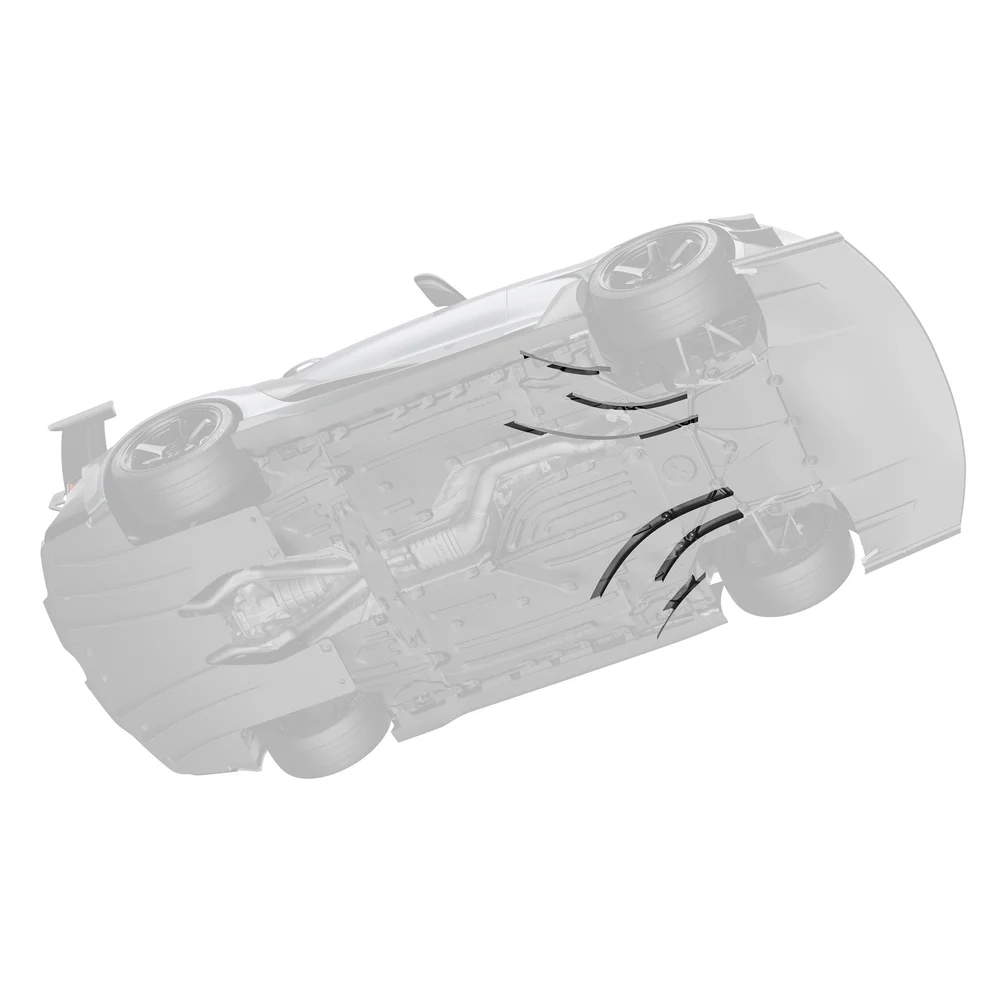
The component most aero kits ignore completely. The one that separates visual modifications from genuine aerodynamic systems. Most kits stop at the surfaces you can see: wings, splitters, canards. The underside of the car is where the most significant aerodynamic gains live, and it is where most kits do nothing at all.
How It Works
Six vanes are strategically positioned beneath the Supra's chassis to transform underbody airflow management. They generate large-scale vortices that dramatically increase suction on the lower surface, pulling the car toward the track with measurable force. Simultaneously, they direct airflow outboard, preventing stagnation under the center section and maintaining high velocity through to the rear diffuser.
The result is dramatic front and mid-section downforce increases without adding drag-inducing topside elements. These are gains that do not show up in photographs but show up immediately on a data logger.

The Rear Diffuser
A diffuser works by taking the high-velocity, low-pressure air traveling under the car and gradually expanding it back to ambient pressure before it exits at the rear. Done correctly, this expansion accelerates the flow ahead of it, increasing suction across the entire underbody. Done incorrectly, or with gaps and interruptions in the undertray that allow turbulent air to mix in, the pressure recovery breaks down and the diffuser produces a fraction of what it should.
The ARD rear diffuser is developed as the endpoint of a complete underbody system, not a standalone component bolted to the rear bumper.
How It Works
The diffuser undertray seals the gaps that cause turbulent recirculation under the car. On a stock Supra, those gaps allow high-pressure air to bleed into the underbody from the sides and center, disrupting the low-pressure environment the diffuser depends on. Blocking them keeps underbody velocity high across the full floor, which means the diffuser strakes have clean, fast-moving air to work with rather than recovering from turbulence upstream.
The strakes inside the diffuser generate vortices that roll along the diffuser surface, energizing the boundary layer and preventing flow separation as the channel expands. This is what allows the diffuser to extract more work from the airflow without stalling. Those vortices are stronger because of what happens upstream: the ARD undervanes generate large-scale vortices that feed conditioned, high-velocity flow rearward through the floor, arriving at the diffuser inlet with enough energy to drive the expansion process effectively.
As part of the complete ARD Aero Package (in ADRO bumper configuration), the system generates 2148N (483 lbs) of downforce at 180 km/h, a 1618% increase over the GR Supra's stock 125N, with a gain of +2023N (455 lbs) and a 45/55 front-to-rear balance.
Material
ARD components are produced in prepreg carbon fiber. Prepreg uses resin pre-impregnated into the fiber under controlled conditions, which means resin distribution is precise and consistent throughout the part. The result is a lighter, stiffer panel with no soft spots or resin-rich areas that can delaminate under sustained load.
For track use, this matters beyond aesthetics. A splitter that flexes under aerodynamic load does not produce the downforce it was designed to. Prepreg eliminates that variable. What the CFD predicted is what the part delivers, lap after lap, in heat and under sustained aero loads.